

In the past, sports journalism was all about the who, what, where and when. Now, the idea of sports journalism is based on the ideas of click, like, share, repost. Society has transitioned from reading the sports section in our local newspapers to viewing the short notifications on our phones. It is indisputable that sports journalism is changing, but are the changes for the better or the worse?
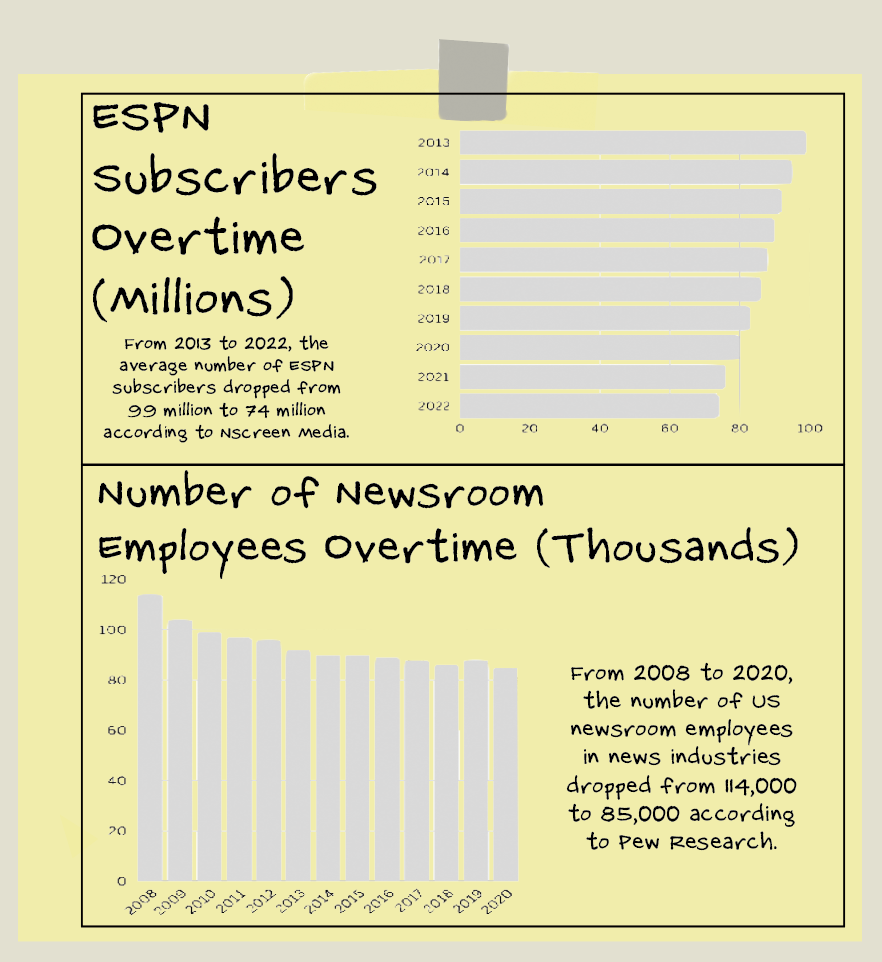
Oftentimes, when people think of sports journalism, they think of ESPN. First launched in 1979, ESPN has always been the core network for sports media in the country, but with evolving times, its authenticity and relevancy has started to decline. The decline of audience trust and engagement is reflected in its platform viewership. According to Dan Shanoff from the Athletic, compared to season averages,“amongst viewers 18-34 years old, viewership was down 54%.” Before social media and the internet, ESPN was the only place that viewers and fans could get access to scores and stories that are exclusive to the network. ESPN was based on investigative journalism and giving the audience information about the sports world.
In the modern world of sports journalism, simple information about the sports world can be found anywhere. From Instagram to TikTok to X to podcasts and more. The idea of breaking big sports news is no longer exclusive to ESPN.
Paly alum and current University of Michigan student Tyler Frick, who is involved in the sports industry, has observed these changes first hand.
“I think the importance of sports writing is declining,” Frick said. “Stories are less read, social media plays a huge part in it. People feel okay reading a headline, or watching a clip on social media to receive news rather than reading a full story, because it takes way less time. It’s dangerous and unfortunate, but that is the way things are trending.”
These changes in the industry have forced mass layoffs for many sports broadcasting companies including ESPN. In the summer of 2023, they let go of many on and off camera talents and allocated more funding toward high-profile personalities like Stephen A. Smith. These cuts are not showing any signs of slowing down and every year there are fewer and fewer active journalists working for ESPN. Many journalists and analysts who specialized in their specific sports and field, now rely on a smaller number of people to be experts on everything.
Morten Bay, a professor and lecturer at USC Annenberg School for Communication and Journalism, has seen this shift across the entire industry.
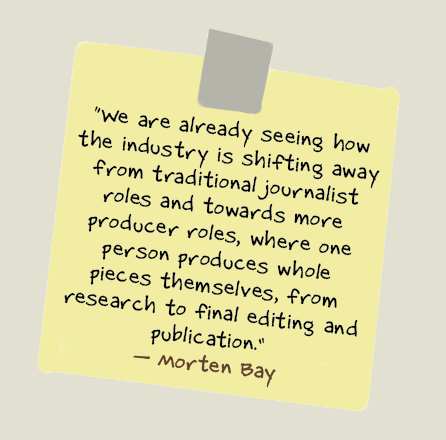
“We are already seeing how the industry is shifting away from traditional journalist roles and towards more producer roles, where one person produces whole pieces themselves, from research to final editing and publication,” Bay said. “This goes for both audiovisual and written journalism.”
Retired sports journalist and author of “Dogs Chase Cars,” a memoir on the decline of the industry, Patrick Sangimino has lived through the changes that have influenced the journalism sector over the last few decades. Sangimino emphasises the repercussions that can come along with the industry’s transition to social media, where many more people have the ability to spread information.
“Social media has created a world where everyone has a voice, but not everyone should have a platform,” Sangimino said. “Distinguishing between well-sourced, trusted information and half-baked opinion has created a situation where no one knows what is true anymore. The cries of fake news, sad to say, are sometimes not so far from the truth. Finding trusted news is a challenge, especially on social media platforms.”
In the modern day, ESPN has transitioned to more of an opinions-based model. One of ESPN’s most popular shows, First Take, is based fully on debating about different stories in the sports world. The show often consists of one host that gives prompts and two or more analysts that debate the topic. Though these shows may be entertaining, they often don’t provide the audience with any extra information or stories about the sports world. In addition to this, these shows are frequently criticized for stating false information. For example, First Take analyst Stephen A. Smith recently stated that the Warriors never made the playoffs since their 2022 championship run, despite them actually appearing twice more. People always make mistakes, but consistently talking off script with the intention of supporting certain opinions can lead to unreliability issues and poor journalism as a whole.
ESPN has also made many big partnerships with professional sports leagues like the NBA and NFL. For example, Monday Night Football and the NBA Finals are fully produced under the ESPN brand. In 2014, Bill Simmons, a well-known journalist for ESPN was fired because of the critical comments he made about NFL commissioner Roger Goodell. He criticized Goodell for lying about the details behind a domestic violence case with former football player Ray Rice. Simmons was fired for using his voice and speaking out against the people in charge of one of the biggest sports leagues in the world.
ESPN has also heavily transitioned to promote sports betting which has caused many to question their credibility.
“[Look at] ESPN’s 180-degree turn on its stance on gambling and you can see the way this could impact journalistic accountability,” Sangimino said.
One of the major factors of journalism in general is the trust between journalists, information providers and the audience.
“Trust is immensely valuable when it comes to developing sources and building relationships,” Sangimino said. “It takes time, but if you’ve built that trust, they’ll have faith in giving you information that they know will be treated responsibly and with great and accurate care. Readers need that kind of trust, too, especially in this age when stories that aren’t agreed with are labeled as ‘fake news.’”
Sangimino believes that changes in journalism have reduced the number of journalists left at the highest level who have an incredibly high level of trust with their sources and speak freely in their stories.
“Very few journalists practice that kind of investigative reporting any longer and for some reason, it’s no longer expected,” Sangimino said.
While there are concerns about the journalism industry dying as a whole, Sangimino believes that the industry may not be declining, it is simply changing.
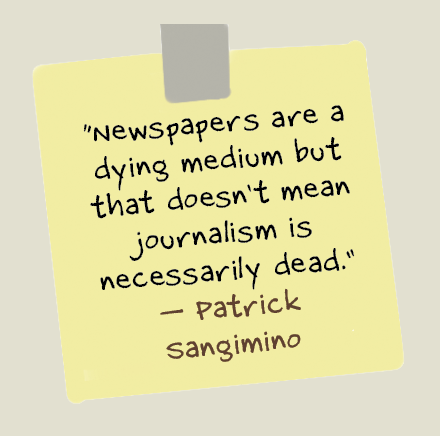
“The internet has become an alternative option to newspapers and dwindling television journalism ratings,” Sangimino said. “Newspapers are a dying medium but that doesn’t mean journalism is necessarily dead. Consider photography’s transformation to digital. Yes, we generally have no use for film anymore, but we still take photos.”
However, this transition to digital media may still have negative effects on the world of journalism.
“With fewer reporters and fewer column inches in the paper each day, most things don’t get covered,” Sangimino said. “High school sports is a great example of this. It was once the backbone of a thriving sports section but most papers don’t have the staff or the room to cover something.”
With fewer and fewer newspapers, news deserts have become more prominent across the United States. News deserts refer to a geographical area with no news outlets and very little coverage. According to a study done by Northwestern Medill, the number of news desert counties rose to 213 in 2025 with an additional 1,524 counties with only one news source. Sangimino also believes that newspapers used to keep people in high positions in check, but as a result of growing news deserts, many people get away with acts that they wouldn’t have in the past.
“City councils and school boards were once watched closely by the local paper,” Sangimino said. “Local politicians were held accountable by the coverage, but that’s no longer the case.”
Many of these problems are a result of money. According to Congress.gov, “Revenues from print advertising declined 92%, from $73.2 billion in 2000 to $6 billion in 2023. Subscription revenues declined by more than 50%, from $15.8 billion in 2000 to $7.8 billion.”
While newspaper revenues have been on the decline, the financial struggles started years ago. Sangimino believes the ignorance of news outlets led to years of financial struggles.
“When the internet first came to be, newspaper publishers were arrogant and naively considered it a fad,” Sangimino said. “As a result, they put their product online for free. When they realized the internet was here to stay, they tried putting up pay walls, but after giving it away, people weren’t willing to pay for it.”
The journalism sector hasn’t only changed in the form of newspapers and magazines but also in multimedia aspects such as podcasts. Edward Hand, a member of the Boston Red Sox podcast, “Pod By The River,” believes the changes have made it harder for listeners to get factual and qualitative information.
“Podcasts are part of a broader shift where anyone can enter sports journalism regardless of background, lowering barriers to entry but also flooding the space with uneven quality that makes credibility harder to assess,” Hand said. “Over time, audiences tend to gravitate toward either the most informed voices or the most compelling personalities, which reshapes influence away from traditional gatekeepers and toward a more fragmented, competitive landscape. As a result, there is no longer a single dominant narrative, and with sports media becoming increasingly subjective, it’s unlikely the industry will return to its previous norms.”
Players and coaches no longer need to go to reporters to give information and opinions on certain topics due to a large increase in podcasts that feature them. From 2022, podcast monthly listeners have increased from one in three to half of the United States 12+ population. Athletes often leak important news that has been previously covered by journalists. Podcasts are changing the way fans get their information and are affecting journalists. Nowadays, there are fewer breaking sports stories published by companies as athletes no longer need journalists to tell them and can do so on their own.
These changes in the sports journalism industry have also brought up many concerns about the difficulties of finding a career in this field. The need for good writers is simply dropping.
“I do think it’s harder to pursue internships and jobs in sports because of the increased number of people wanting to work in sports.” Frick said. “People like me follow their passion and it has led to an oversaturation as far as finding jobs and pay. There are avenues within the sports industry where people take 50%+ pay cuts vs. other industries because solely working in sports is more culturally significant and fun.”
This unyielding passion from many people may be the factor that keeps the industry afloat.
“I do believe there is an advantage with sports journalism,” Bay said. “It’s not something anyone with a degree in journalism can do, it requires specialization. Thankfully sports is both a massive entertainment business as well as an area where most people have some sort of interest. In other words, whatever happens to news, there will always be a need for people who can produce sports news and content.”
Recent technological advancements have also been a factor of creating the declining need for news outlets, especially AI. However, AI can still be full of many inaccuracies and most likely won’t fully replace human journalists for a while.
“As for AI, I fear that it is an amalgamation of information, some of it bad info,” Sangimino said. “So, just like Wikipedia, it isn’t always trustworthy or even true.”
An important factor in journalism is the human element as this factor takes raw statistics and turns them into words with weight. Technology won’t be able to replace human factors such as ethics and unpredictability.
The current state of journalism is filled with news deserts, media personalities and a void filled with mistrust. When media outlets prioritize revenue and not real reporting, the audience doesn’t get the true breakdowns that they deserve. As a result of the fading human element, there is a lack of accountability that can be enforced by the news. From news deserts to a rise in podcasts, journalism has been changing with the world; while some changes are for the better, others take away important factors that make journalism what it is.