



Heading into Week 15 of the 2024 NFL season, the Pittsburgh Steelers were rolling with a 10-3 record and held the top spot in the AFC North division. However, a brutal stretch of scheduling would soon derail their promising season. In a span of just 10 days, the Steelers would go on to lose three games in a disappointing fashion. The high level of competition and limited rest time was just too much for the Steelers to keep up with. Later that season, they would eventually lose to the Ravens in the wild-card round. While it is easy to focus on player and coaching performances, scheduling in sports is an impactful factor that is often overlooked.
Depending on the sport, different sports teams will schedule their seasons in their own unique way. For example, the MLB requires each of the 30 teams to play 162 games each season. It is required that each team play each other at least once. Additionally, teams typically play one mid-week series and one weekend series per week. Given these requirements, the Sports Scheduling Group LLC is currently responsible for creating the MLB (Major League Baseball) schedule and will meticulously organize and coordinate the schedule for the season.
Similarly, the MLS (Major League Soccer) has 30 teams, and each team plays 34 matches each season. However, unlike the MLB, of these 34 games, 17 must be home and 17 must be away. Additionally, the MLS Game Schedule Management department is the organization that organizes the game schedule for the league.
Lastly, the NBA requires each of its 30 teams to play 82 per season. Unlike both the MLB and the MLS, the NBA requires that each team play four games against each of the four other teams in its division, adding another layer of complexity for the NBA’s team of league executives to consider.
At Paly, the Athletics department leaves the scheduling to the SCVAL league, to which each respective Paly athletics team belongs.
“Coaches can choose who they would like to play for a non-league (non-SCVAL) game,” Paly’s athletic director, Scott Davis said. “Each sport has a limit on how many, and the coach can choose who they want to schedule.”
Furthermore, Davis explained how the responsibility for scheduling games falls on the coaches.
“Sometimes coaches will try to schedule games against similar-sized schools to help them prepare and qualify for Central Coast Section Playoffs,” Davis said. He explains that, in regard to scheduling, he works with all the coaches for facility schedules so each team has an equal opportunity for their practice times, as well as ensuring minimal conflicts.
Paly baseball assistant coach Peter Colombo schedules his games based on the priorities of the other coaches in the area.
“I schedule the Paly program baseball games at the beginning of June every year, and I use my coaches contact list to get games,” Colombo said. “When you have been coaching for 25 years, you get to know all the coaches and solid programs. We try to schedule at least three WCAL practice games a year to get the program ready for the SCVAL De Anza, which is the best public school league in the CCS.”
For Jeff LaMere, who coaches the Paly varsity boys basketball team, emphasizing the time commitment to his players gives them a clear understanding of what is required to play the sport.
“One of the biggest challenges—for both players and coaches—is the commitment required. Basketball is a demanding sport, and the schedule requires a lot of sacrifice,” LaMere said. “We play games over thanksgiving and winter Break, and for varsity players, also during the February break.”
Athletes who play a winter sport often have games scheduled over break, forcing them to sacrifice time spent with family and friends, as well as time to relax their physical and mental spaces. Many athletes come into the sport knowing that they will have to sacrifice their winter break, and they find it part of the sport they play.
“Winter break basketball is one of my favorite times because you get really close with the team,” senior Jake Wang said. “Everyone stays home instead of going on vacation, and most of what you’re doing is playing basketball and hanging out with your teammates.”
While schedules are an issue for high school athletes, overpacked schedules are an even bigger problem in the world of international soccer. In recent years, many have grown concerned over the world’s sports becoming increasingly artificial. This was exemplified in the most recent FIFA Club World Cup which was hosted in the United States in this past summer. Some teams had their last gameweek of the regular season just two weeks before the start of the tournament, which. While summer tournaments like the World Cup, Copa America and the Euros have existed, the introduction of this new format means that the best players are playing year round, almost every summer without a break. Such as fullback Achraf Hakimi, who had played over 225 games from the start of the 2021-2022 season to the start of this season for Paris Saint Germain and the Moroccan National Team.
This highlights a bigger problem in professional sports. A shift in focus away from the quality and wellbeing of athletes, and towards maximizing revenue and entertainment value. Professional athletes are being overworked and not given adequate time to rest and recover. A study by the CIES Football
Observatory in 2021 found that the average player in the English Premier League covered 9.16 km (5.69 miles) per match. Due to the number of competitions the most elite athletes play in and with the number of matches in tournaments like the UEFA Champions League increasing dramatically, meaning that many athletes are often playing multiple matches a week. Similarly, The NBA has 82 games in the regular season and is one of the most demanding professional sports leagues in the world. In the games that they play, the NBA players are expected to perform at the highest level with little to no rest days. In this year’s NBA playoffs, the schedule was packed tight, requiring extra effort, extra focus in addition to the travel and lack of rest. Sometimes it can also result in players getting on a plane after a game and having to play the following day.
Athletes sometimes struggle with mental health and may feel like they have too much to handle on their plates.
“I don’t really struggle with mental health wissues, but sometimes players on the tennis team may feel burnt out with all of the practices and matches, but I feel like we are very supportive of each other and are able to bring each other up,” Thomas Li said.
Unlike professionals, who have access to the best trainers, doctors, and recovery methods, high school athletes usually don’t have access to such high-end recovery facilities and physical trainers.
“As a wrestler, I sometimes find myself struggling to recover after a tough practice,” wrestling sophomore Reed Hoffman said. “High school facilities aren’t the best but I try to do what I can to get my body right for the coming days.”
The MLB plays the most games out of any professional sport, with 162 games in every season. The season lasts from late March to late September. MLB players only average one day off every two to three weeks, which results in numerous injuries across the league. About 400-500 players get hurt every year , and the league averages thousands of missed games due to injury. Injuries can range from mild strains to torn elbow ligaments. Many baseball players believe that the increased load of every season has resulted in shorter seasons, often caused by injuries.
This experience also occurred to junior Willem Madwed, a former Palo Alto baseball player.
“From my own experience, this schedule led to true overwork, which showed up in the form of shin tendonitis,” Madwed said. Having loved baseball since I was four years old, it’s tough to watch my interest fade because of something out of my control.”
Some common injuries include shin tendonitis, elbow, knee, and ligament injuries.
He experienced more difficulties during that season, which resulted in a tough predicament.
“As the season went on, I found myself stuck between wanting to play and needing time off to recover,” Madwed said. “As I wanted to balance playing and injury somehow, I relied on Ibuprofen before every practice, but eventually, even that stopped working after about a month, leaving me in a bad position.”
MLB teams have also complained about the lack of time they get to rest on travel days. Many teams finish games very late at night and have to get on the plane and travel across the country to play an early game.
Many athletes have to and must work hard to balance their time between school and athletics.
“I think absolutely as an athlete you are expecting a busy schedule,” Jake Wang said. “When you start taking AP classes and harder classes during junior year, that’s when it starts to get harder while still doing everything I can to be the best athlete that I can.”
Athletes at Paly spend a lot of time on the field, taking away from the time they have for schoolwork and other activities. Struggles with scheduling are common, and many find themselves lacking time to complete important assignments and study for big tests.
“As a baseball player at Paly, the time commitment on the field is a lot when comparing the work I get from the classroom. During the spring season, the team typically spends 15–17 hours a week between practices and games (personal estimate),” Madwed said.
But not all players struggle with packed schedules, as some of that depends on the amount of physic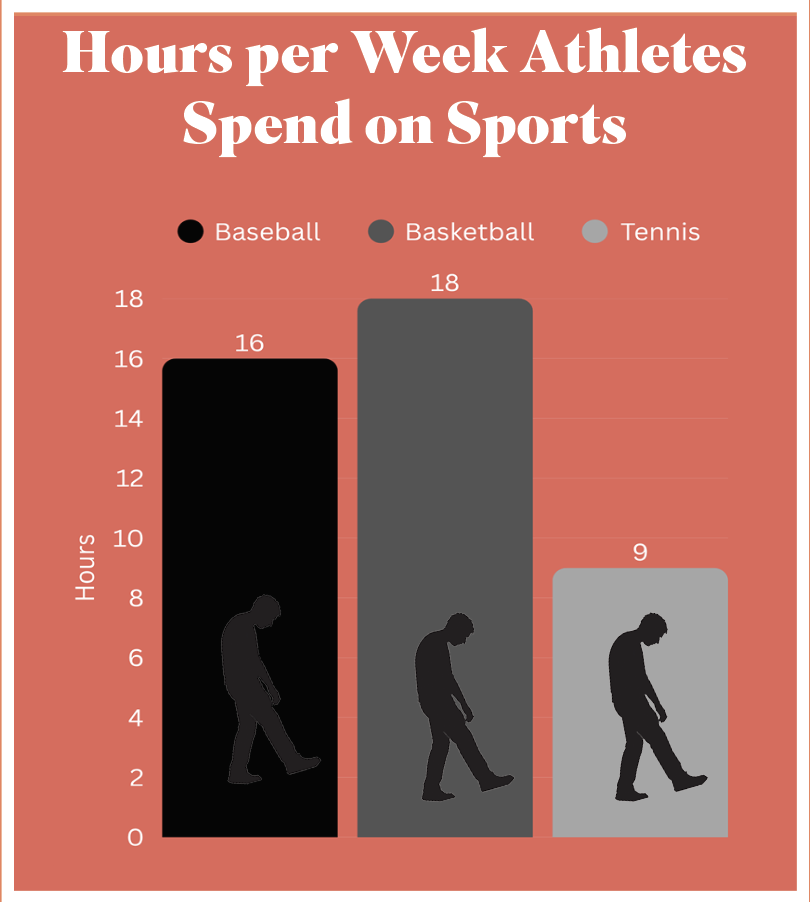 al overwork in practice and games.
“Some people don’t experience these struggles of physical overwork during practices and games, it really just depends,” senior football player Kevin O’Brien said. “I haven’t personally been seriously injured from being overworked, but I have seen players around me get injured for sure.”
Thomas Li finds making time for schoolwork after a long day especially difficult. But, he is able to stay on top of his work which allows him to keep most of his energy on tennis.
“Staying on top of all the schoolwork is always my number one priority but I sometimes find myself too tired to do my work,” Li said. “But, I always try to finish my homework and study on time, even if I’m losing my free time and missing parties.”
As the packed schedules for many athletes continue to increase and they experience difficulties in their physical and mental health, this has become an issue that more people need to be aware of. In the future, high school and professional sports could make changes to provide resources to help athletes’ mental and physical health, as ultimately, athletes’ well-being is the top priority.